Kwinana vs Wellard: Where Should You Build Your First Home?
Comparing Kwinana and Wellard for your first build? Here is how the two areas differ on transport, amenities and housing, and what to check before you choose.
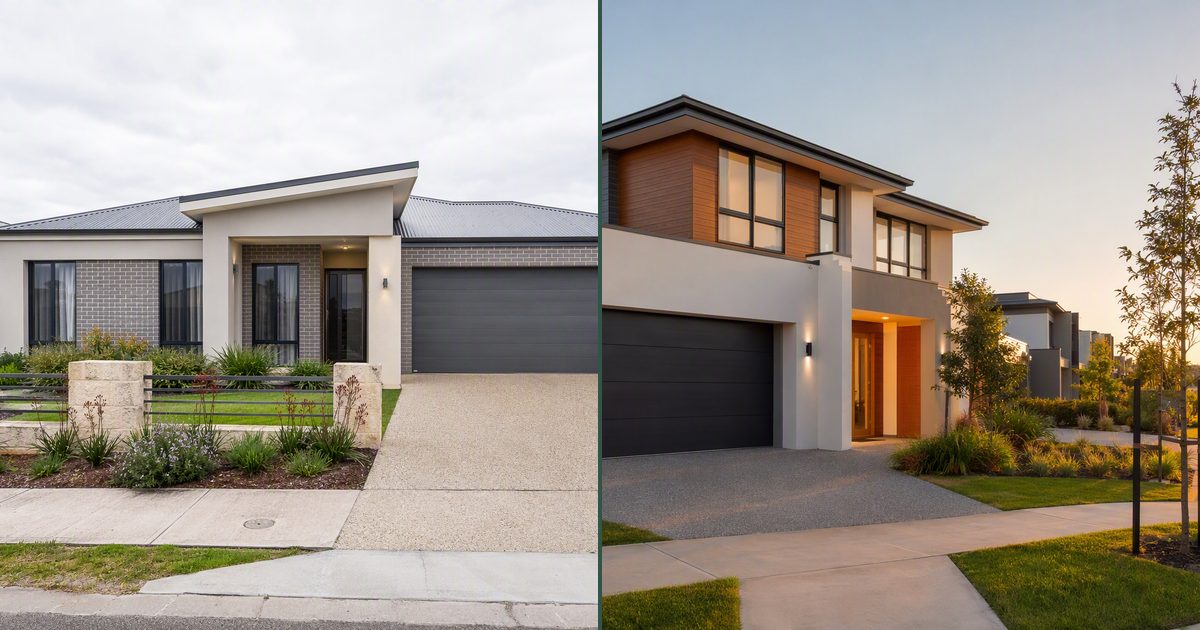
If you are building your first home south of Perth, Kwinana and Wellard both come up early. They sit close together, both are served by the Mandurah rail line, and both have had new residential land released over the past two decades.
Neither is universally better. What decides it is your budget, how you travel to work, whether you would rather live somewhere established or somewhere still filling in, and what is genuinely available in your price range when you are ready to sign.
One thing is worth clearing up first, because it changes how you should read every comparison you find online.
They are not two different councils
Wellard is a suburb within the City of Kwinana. So is Kwinana Town Centre, along with Bertram, Calista, Casuarina, Leda, Medina, Orelia, Parmelia, Anketell, Mandogalup and Wandi.
That has practical consequences. Council rates, local planning decisions, libraries, waste collection and community facilities are administered by the same local government in both cases, and both sit inside the federal division of Brand.
So this is a comparison of two areas inside one local government area, not a choice between two councils with different rules. It also explains why a search for house and land in Kwinana may show you lots in Wellard, Bertram or Leda — they are all part of the same district.
Kwinana and Wellard at a glance
| Kwinana | Wellard | |
|---|---|---|
| Local government | City of Kwinana | City of Kwinana |
| Postcode | 6167 (Kwinana Town Centre) | 6170 |
| Federal division | Brand | Brand |
| Nearest station | Kwinana station | Wellard station |
| Rail distance from Perth | 32.9 km | 37.1 km |
| Train time to Perth | About 26 minutes | About 30 minutes |
| Transperth fare zone | 4 | 4 |
| Main shopping | Kwinana Marketplace | Wellard Square |
| Character | Established civic and commercial hub, surrounded by older residential suburbs | Largely residential and newer, planned around the station |
| Population, 2021 Census | 567 in Kwinana Town Centre itself, across 0.8 km² | 14,127 across 16.3 km² |
Those last two rows look stranger than they are, so they are worth explaining rather than glossing over.
What is it like to build in Kwinana?
Kwinana Town Centre is not really a residential suburb. It covers about 0.8 square kilometres and recorded 567 residents at the 2021 Census, because most of it is civic and commercial rather than housing.
What it holds instead is the everyday infrastructure for the wider district. Kwinana Marketplace anchors the shopping with Woolworths, Coles, Big W and more than 70 retailers, plus around 1,500 parking bays. The Kwinana Recreation Centre, Kwinana Aquatic Centre, the police station, the City of Kwinana Council Chambers and the Koorliny Arts Centre are all in the same precinct.
So a first home buyer "looking at Kwinana" is usually not looking at the town centre itself, but at the surrounding residential suburbs that use it — and that is where new land tends to be.
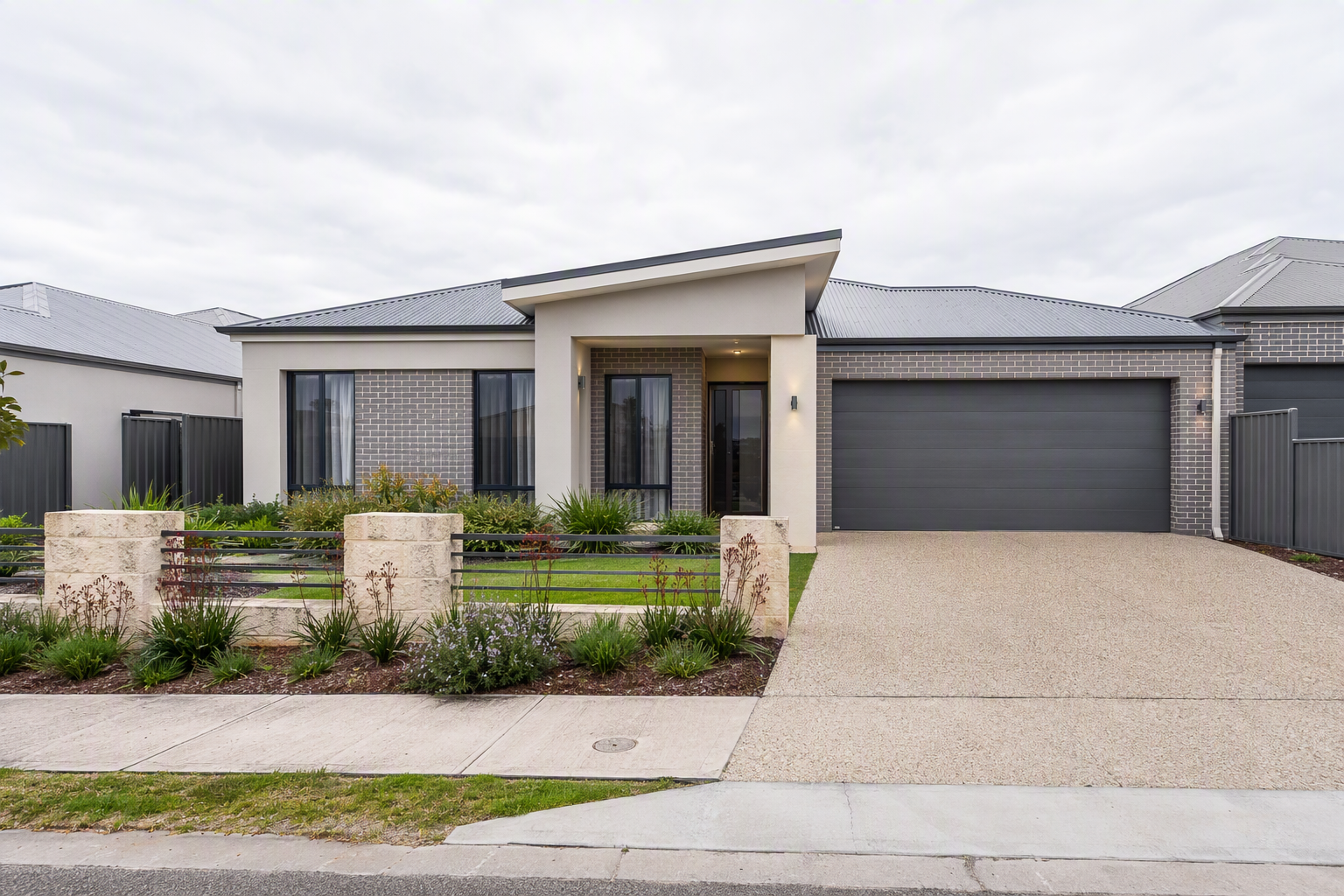 Housing styles vary considerably across the Kwinana district, from established suburbs built decades ago to recent estates. Images are indicative only and do not represent any specific available package.
The upside is that those suburbs were largely built before you arrive. Shops, schools, sporting facilities, medical services and public transport already exist rather than being staged in over several years.
Kwinana station's name is misleading: it sits on the boundary of Bertram and Parmelia, roughly 1.5 km from the town centre. It is 32.9 km from Perth by rail, about 26 minutes.
The district is also close to the Kwinana industrial area along Cockburn Sound, a long-established employment precinct and part of why the area developed as it did. If you work in that corridor, a short commute is a genuine financial advantage rather than just a convenience.
Because the district covers many suburbs at different stages, lot sizes, frontages and site conditions vary considerably across it. Our page on house and land packages in Kwinana covers what to look at locally.
What is it like to build in Wellard?
Wellard is a different proposition. It covers 16.3 square kilometres and recorded 14,127 residents at the 2021 Census, up from 3,246 in 2011 — so much of the housing stock is relatively new.
That growth was planned. The Village at Wellard is a 320-hectare mixed-use development, a joint venture between the Western Australian Department of Housing and Peet running since 2003 and intended to accommodate around 1,700 households at completion. It was Perth's first transit-oriented development on the Perth to Mandurah rail line, meaning the housing was planned around the station rather than the station added later.
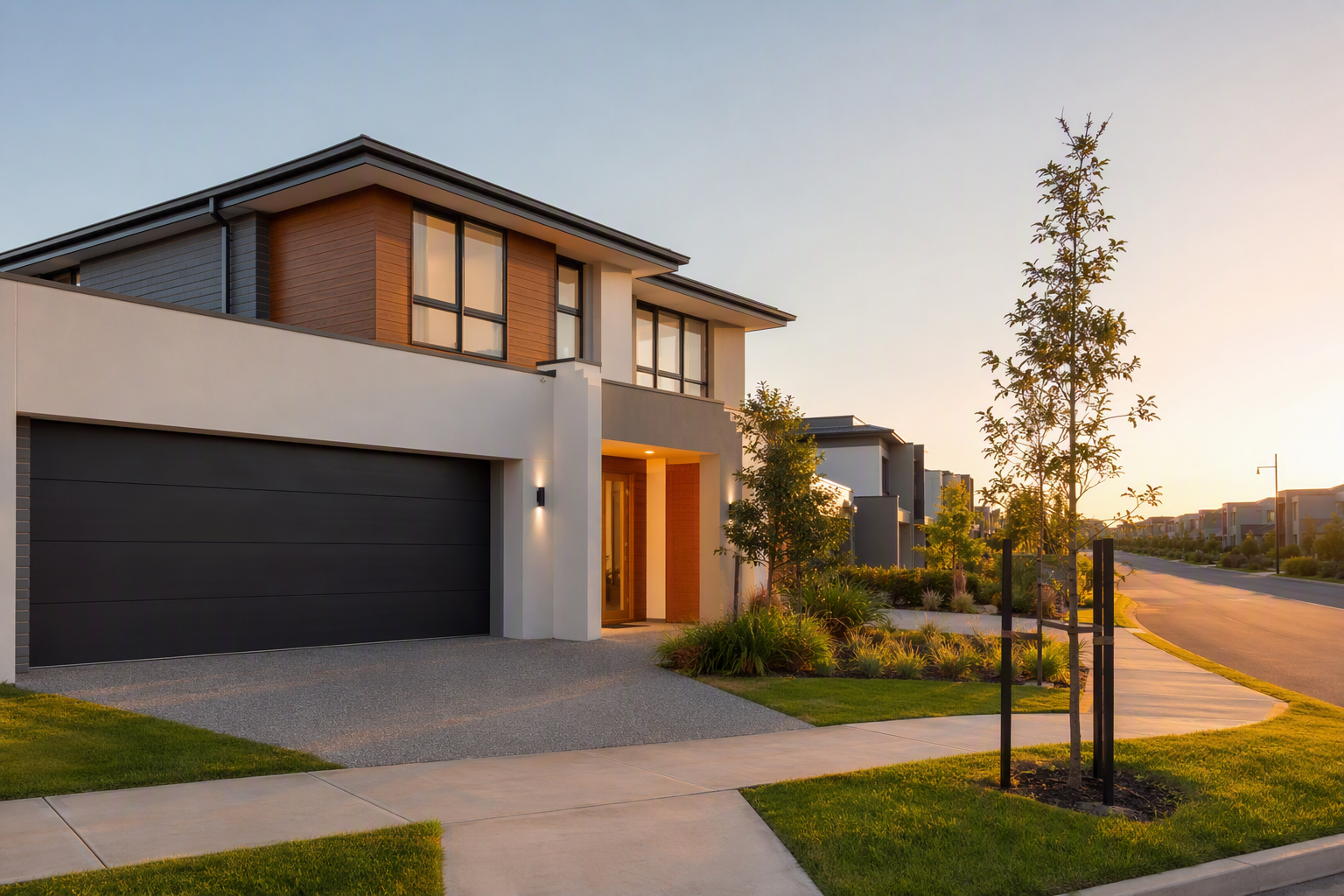 Wellard's residential areas were planned around the train station. Images are indicative only and do not represent any specific available package.
That has consequences you can use. Parts of Wellard are genuinely walkable to the station, which is unusual in outer Perth. The development includes more than 57 hectares of parkland and conservation areas. Housing ranges from freehold homesites through to medium density and apartments, so the entry price is not a single number.
Everyday shopping is served by the Wellard Square precinct, developed around the station with Woolworths as the anchor tenant, and the John Wellard Community Centre sits in the same precinct.
Wellard station is 37.1 km from Perth, about 30 minutes. It is fully accessible, with lifts, an escalator and stairs to each platform, a staffed customer service office, a kiosk, fare gates, a bus interchange with four stands and 297 parking bays.
If Wellard is on your list, our page on house and land packages in Wellard goes into more detail.
Which has more house and land options?
We are not going to give you a number, and it is worth saying why.
Availability changes continuously. Stages sell out, titles are issued, and builders revise or withdraw package offerings. Any count published in an article is out of date almost immediately and would give you false confidence. Knowing what to ask is more useful:
- How many titled lots are available in your price range, as opposed to lots still awaiting title?
- Which stages release next, and roughly when?
- Are the packages tied to one builder, or can you compare builders on the same lot?
- Is the advertised price for that specific lot, or a starting price on a hypothetical block?
As a matter of how the two areas developed rather than current stock: Wellard's new housing has come largely through one large planned project, while the Kwinana district spreads its activity across several suburbs at different stages. That shapes the kind of options you tend to see, not what is available today.
Which is better for public transport?
The difference is smaller than most buyers expect. Both are on the Mandurah line, both sit in Transperth fare zone 4, and both have the same frequency: every 10 minutes in weekday peak, every 15 minutes outside peak, half-hourly or hourly at night, with all services stopping at all stations. Both stations are fully accessible, with a bus interchange and park-and-ride.
Two genuine differences remain. Kwinana station is closer to the city — 32.9 km and about 26 minutes, against 37.1 km and about 30 — so roughly four minutes quicker. Wellard's advantage is not speed but proximity: parts of the suburb are within walking distance of the platform, whereas Kwinana station sits about 1.5 km from the town centre, so many surrounding streets mean driving, cycling or catching a bus.
Four minutes each way is about 40 minutes a fortnight. Whether that beats being able to walk to the platform depends on where the specific lot sits, so measure the walk from the block rather than from the suburb name.
Which may suit first home buyers better?
Kwinana may suit you if you work in the industrial corridor or elsewhere in the southern suburbs, you would rather live somewhere already built out with established services, you want to compare lots across several suburbs and price points, or a slightly shorter train trip matters to you.
Wellard may suit you if walking to the station is genuinely valuable, you prefer a newer and more uniformly recent streetscape, parkland access is a priority, or you want a choice of housing types inside one area.
Two cautions. An established area means established housing stock, some of it much older than a new build, which affects the character of the street you would be building in. A newer area can still have construction activity nearby for some years, and later stages may not be finished when you move in. Ask about both.
What to compare before you choose
Once you have a shortlist of actual lots rather than suburbs, compare them on the same terms:
- Total house-and-land price — the combined figure, not the house price advertised separately.
- Land title status — titled now, or titles pending? This affects when you can start.
- Block size, frontage and orientation — frontage drives which designs will fit; orientation affects light and running costs.
- Site works and inclusions — costed for that specific block or carried as an allowance that can move, and what is actually in the specification rather than the display home.
- The building contract — fixed price or not, what can still change, progress payment stages, build timeframe.
- Transport, schools and commute — the real walk from that block to the station, current catchments confirmed with the schools and the Department of Education, and the drive at the time you would actually travel.
- Future development on the surrounding land, available through the City of Kwinana.
- Finance and the costs outside the build contract — settlement costs, government fees, and how construction lending works.
Item four is where packages that looked similar separate most sharply. Our guide on what is included in a house and land package works through the inclusions and exclusions in detail.
First home buyer considerations
A few things differ from buying established, and the financial settings change from time to time — so treat this as orientation and verify the current detail yourself.
Construction finance is drawn down in stages as the build progresses rather than paid as one lump sum at settlement, and you generally pay interest only on what has been drawn.
The First Home Owner Grant applies to new homes only. In Western Australia it is a one-off payment of up to $10,000, not available for established homes or for vacant land on its own, with no income or assets test. Under the settings from 7 May 2026 the cap on total value south of the 26th parallel — which includes metropolitan Perth — is $800,000, and you must live in the home as your principal place of residence for at least six continuous months, starting within 12 months of completion.
Transfer duty is a separate entitlement. From 7 May 2026 the link between the grant's value caps and duty eligibility was removed, so you may qualify for a duty concession where the grant is not payable. On the rates applying from that date, eligible first home buyers pay no duty up to $600,000 with a concessional rate to $800,000; for vacant land the nil threshold is $450,000 with a concessional rate to $550,000. An off-the-plan concession also operates, extended to 30 June 2028.
These thresholds have changed more than once recently, so confirm the current figures and the full eligibility criteria with RevenueWA before relying on them. Our first home buyer guide covers the wider process. We are an information and enquiry service, not a lender, broker or financial adviser, so nothing here is financial advice or a statement that you will qualify.
Kwinana or Wellard — how to decide
The comparison is closer than the framing suggests: same local government area, same rail line, same fare zone, same train frequency, about four minutes apart.
The difference is character rather than geography. Wellard is a newer, planned, station-centred area with a concentration of recent housing and open space. The wider Kwinana district offers established surrounding infrastructure and a broader spread of suburbs, price points and lot types to compare across.
So work out your budget and your non-negotiables first, then look at what is actually on the market in both areas within that budget. Buyers who start with a suburb and then force a budget to fit it usually compromise on the house; buyers who start with the budget and stay open on the suburb tend to get more of what they wanted. Often the answer is a specific lot rather than a suburb — and it may be in a neighbouring one.
Not sure which area suits your plans?
Tell HomeLot your budget, the areas you are considering and what you need in a home, and we can help you explore suitable house-and-land options across Perth's southern suburbs.
We are an independent information and enquiry service. We are not a builder or developer, we do not own land or packages, and we cannot promise that something matching your requirements will be available at any given time — what we can do is help you compare what genuinely is.
When you are ready, tell us what you are looking for.